Exercise Balls
Best Exercise Balls (2026)
Updated 2026 · 15 min read · 10 products reviewed
Disclosure: FlowMatRise is reader-supported. When you buy through links on this page we may earn an affiliate commission at no additional cost to you. Full disclosure.
An exercise ball is one of the few pieces of equipment where getting the size wrong makes it actively worse than owning nothing. A ball that is too small pushes your knees above your hips and rounds your lower back the moment you sit. A ball that is too large leaves your feet reaching, which removes the stability you were trying to train.
This comparison covers two distinct tools that share a category. Full-size stability balls, from 45cm to 85cm, are what you sit on, roll on, and plank against. Nine-inch mini Pilates balls are a completely different prop — you squeeze them, wedge them behind a spine, or place them under a hand to make a stable position unstable. Most practices eventually want one of each.
The specifications worth reading are anti-burst rating, static load rating, wall thickness, and surface finish. Everything else on a stability ball box is marketing. We have organised these ten around real use cases — general core training, clinical and rehab work, prenatal sitting, and small-space Pilates — so you can start from what you plan to do rather than from a number.
| Product | Best For | Key Feature | Top Con | Link |
|---|---|---|---|---|
| 1. Trideer Yoga Ball for Exercise, Pilates & Core Training | A single do-everything ball for core work, desk sitting, and stretching | Anti-burst PVC with a matte, mat-friendly finish | Requires a follow-up top-up after stretching | View |
| 2. kisnbld Small Exercise Ball, 9-Inch Mini Pilates Ball | Inner-thigh activation, spinal articulation, and small-space Pilates | Standard 9-inch studio Pilates sizing | Small inflation plug is easily misplaced | View |
| 3. ProBody Pilates Ball Small, 9-Inch | Barre and Pilates students who want a reliable, studio-familiar mini | Consistent wall thickness with straw inflation | Glossy surface slips on bare tile | View |
| 4. APEXUP Yoga Ball, 660 lbs Anti-Burst, 5 Sizes | Users outside the average height range who need a properly sized ball | Five sizes spanning 45cm to 85cm | Big sizes are slow to inflate by hand | View |
| 5. YOTTOY Anti-Burst Exercise Ball | Plank and stir-the-pot work where forearms rest on the ball | Lightly textured anti-burst surface | Texture attracts floor dust | View |
| 6. Fitvids Anti-Burst Birthing Ball, 2,000-lb Capacity | Prenatal sitting, gentle mobility, and users who want maximum reassurance | 2,000 lb static load rating | Damped feel offers less core challenge | View |
| 7. ProBody Pilates Yoga Ball, Gym Grade, 880 lb Load, PT & Prenatal | Physical-therapy homework and structured rehab programmes | 880 lb gym-grade load rating | Firm feel is less forgiving for beginners | View |
| 8. Trideer Exercise Ball, Stability Ball, 55/65/75cm | Desk-chair replacement and everyday core sessions | Three mainstream sizes with shared anti-burst build | No sizing for very short or very tall users | View |
| 9. Trideer 9-Inch Pilates Ball, Small Exercise Ball | Stability drills where the mini ball goes under a hand or foot | Thicker wall for firmer inflation | Less comfortable for deep thigh squeezes | View |
| 10. KEEP Exercise Ball Anti-Burst, Thickened | Anyone frustrated by a previous ball going soft too quickly | Thickened wall for longer pressure retention | Slower to inflate than thinner-walled balls | View |
The picks in full
Considerations are shown first on every pick — the reason to hesitate is more useful than the reason to buy. Expand a section for the full case, the intended user, and how to get the most out of it.

Trideer Yoga Ball for Exercise, Pilates & Core Training
A well-judged all-purpose stability ball: thick anti-burst PVC, a slightly matte surface that does not squeak on hard floors, and a pump that actually reaches full inflation.
Considerations
- Needs a second top-up 24-48 hours after first inflation as the PVC stretches
- Faint vinyl smell for the first few days in a closed room

kisnbld Small Exercise Ball, 9-Inch Mini Pilates Ball
A nine-inch mini ball, the prop that turns a generic mat class into a Pilates class — squeeze it, sit on it, or wedge it under a spine.
Considerations
- The tiny plug is easy to lose if you deflate it often
- Under-inflating too far makes it collapse rather than support

ProBody Pilates Ball Small, 9-Inch
ProBody’s mini ball has been a studio staple for years, and the reason is consistency — the wall thickness does not vary between units the way cheaper minis do.
Considerations
- Surface is glossier than some minis and can slip on bare tile
- Straw inflation is slow if you fully deflate it between sessions

APEXUP Yoga Ball, 660 lbs Anti-Burst, 5 Sizes
Five sizes from 45cm to 85cm, which is the point: sizing a stability ball to your leg length matters more than any spec on the box.
Considerations
- Larger sizes take real effort to inflate with the bundled hand pump
- The biggest ball needs a high ceiling for standing overhead work
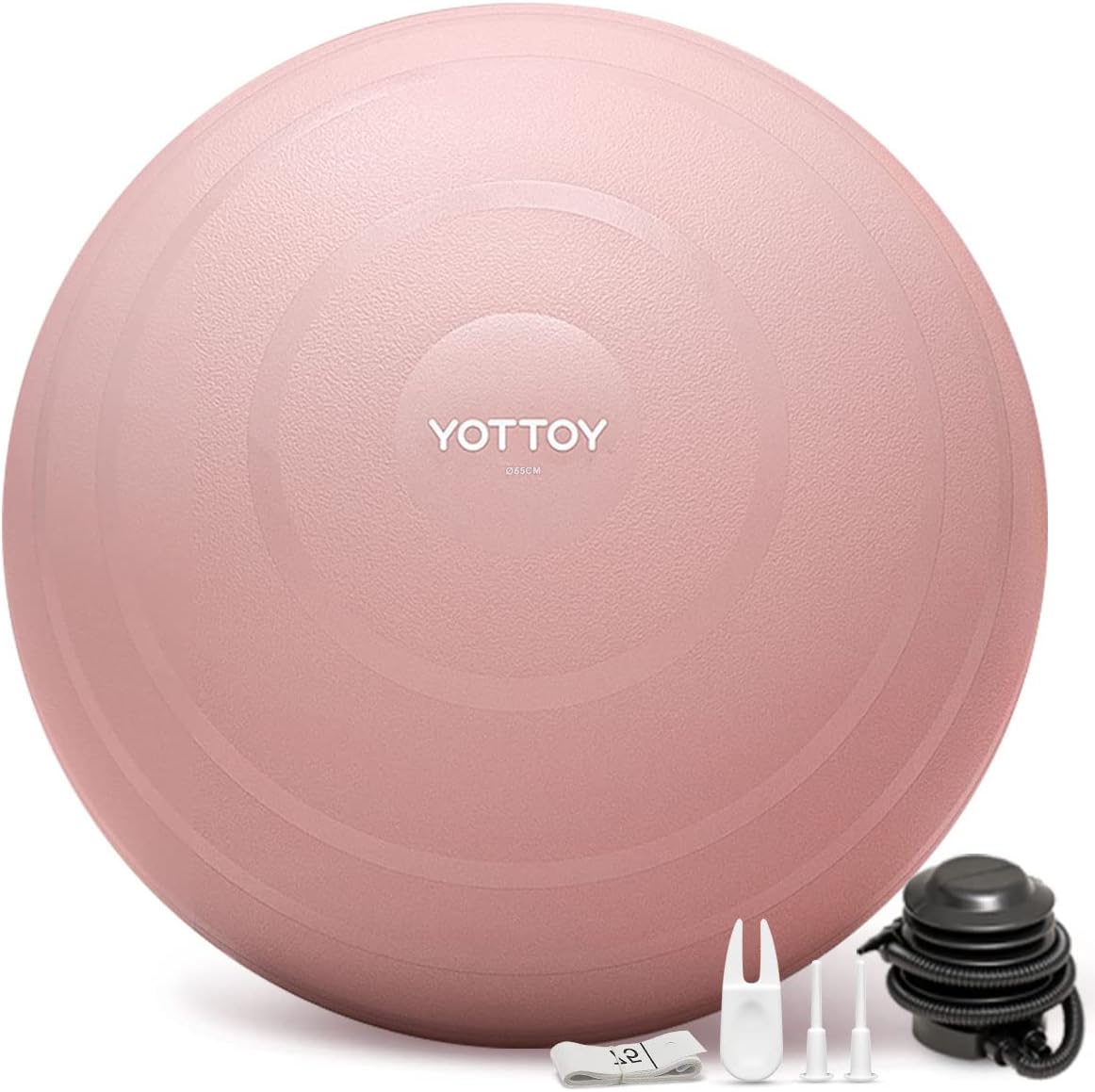
YOTTOY Anti-Burst Exercise Ball
A straightforward anti-burst ball with a lightly textured surface that helps when you are working in grip socks or bare skin contact.
Considerations
- Texture picks up floor dust and needs wiping before mat contact
- Pump included is basic and slow

Fitvids Anti-Burst Birthing Ball, 2,000-lb Capacity
Rated to 2,000 lb static load and sold as a birthing ball, which in practice means thicker walls and a slower, more predictable response underneath you.
Considerations
- The damped feel gives less stability challenge for advanced core work
- Heavier than a standard ball once inflated
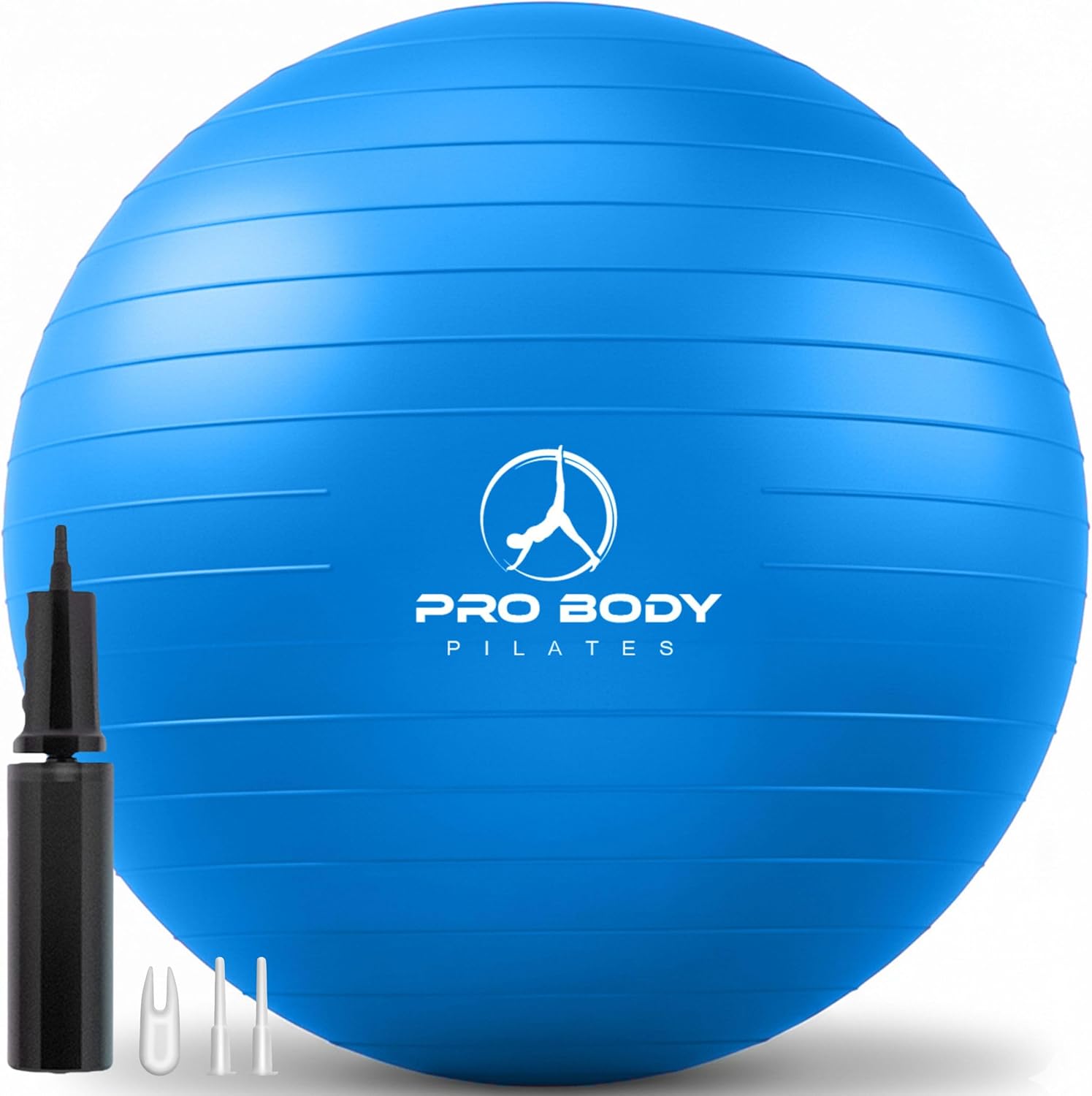
ProBody Pilates Yoga Ball, Gym Grade, 880 lb Load, PT & Prenatal
A gym-grade ball built for the physical-therapy corner: 880 lb load rating, a firm sidewall, and sizing guidance that assumes a professional will be prescribing it.
Considerations
- Firmness is less forgiving for beginners still finding their balance
- Glossy finish shows scuffs from gym flooring
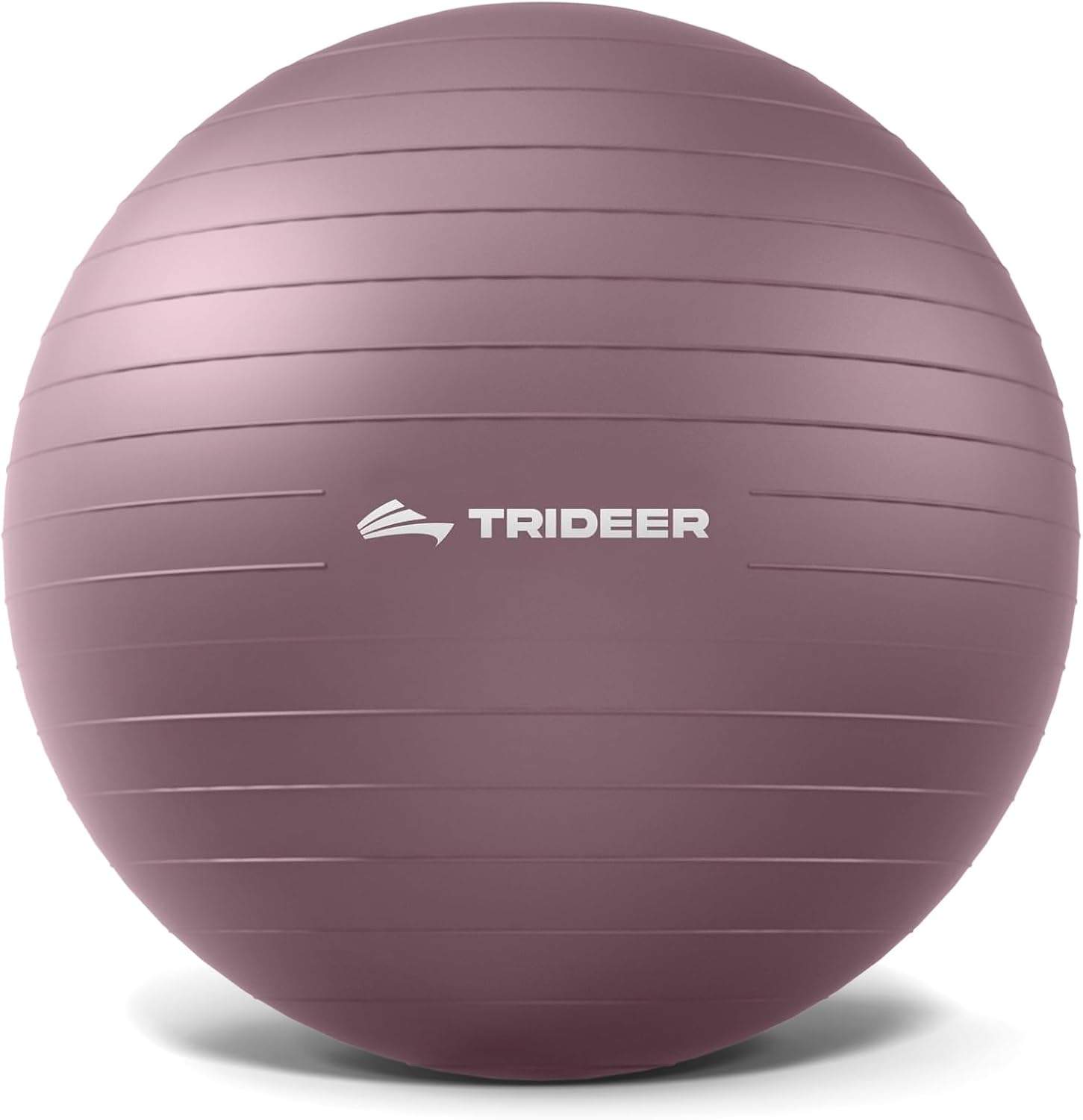
Trideer Exercise Ball, Stability Ball, 55/65/75cm
The three-size version of Trideer’s stability ball, covering the range that fits most adults without pushing into specialty sizing.
Considerations
- No option for very short or very tall users
- Needs re-inflation every few weeks with regular use

Trideer 9-Inch Pilates Ball, Small Exercise Ball
Trideer’s take on the nine-inch mini, with a slightly thicker wall than most — it holds a firmer inflation without feeling like a beach ball.
Considerations
- Firmer wall makes deep thigh squeezes less comfortable
- Needs a straw or thin pump nozzle to inflate precisely

KEEP Exercise Ball Anti-Burst, Thickened
A thickened anti-burst ball aimed at people who found their last ball too soft and too quick to lose pressure.
Considerations
- Takes longer to inflate because of the wall thickness
- Limited colour choices compared with rivals
Buying guide
Size the ball to your legs, not to a height chart
Height charts are a starting point, not an answer. Leg length varies independently of total height, and the measurement that matters is what happens at your knee when you sit. Inflate the ball, sit on the top of it with your feet flat and hip-width apart, and look at your thighs: they should be parallel to the floor or angled very slightly downward toward your knees.
If your knees sit higher than your hips, the ball is too small and every minute you spend on it reinforces a rounded lumbar spine. If your feet barely reach or you feel perched, it is too large. As a rough starting point: 55cm suits roughly 5'0" to 5'5", 65cm suits 5'6" to 6'0", and 75cm suits taller users — but confirm by sitting, and remember that a firmer inflation effectively makes a ball larger.
Anti-burst is a failure mode, not a guarantee
Anti-burst construction does not mean the ball cannot be punctured. It means the material is layered so that a puncture causes a slow deflation over seconds or minutes rather than an instantaneous pop. If you are ever going to sit on a ball at a desk, use it prenatally, or load it with weight, this is a non-negotiable feature — the difference between settling gently to the floor and dropping several inches without warning.
The static load rating printed on the box (660 lb, 880 lb, 2,000 lb) describes weight resting on the ball, not dynamic force. It is a useful comparative signal about wall thickness and build quality rather than a literal capacity you should approach. Higher ratings generally correspond to thicker walls, which also means slower inflation and a more damped, less reactive feel.
Inflate in two stages, always
This is the step almost everyone skips. New PVC stretches. Inflate the ball to roughly 80 percent of its rated diameter, leave it for 24 to 48 hours at room temperature, then top it up to full. If you inflate straight to full, the material relaxes over the following days and you end up with a ball that measures noticeably under its stated size — which quietly changes your knee angle and undoes your careful sizing.
Measure with a tape across the top of the ball to the floor rather than judging by feel. A ball can look full and sit an inch and a half under its rated diameter. Re-check monthly if you sit on it daily; a ball used as a desk chair loses pressure far faster than one used twice a week.
Mini balls are a different tool entirely
A nine-inch Pilates ball is not a small stability ball. It is under-inflated on purpose — usually to about three-quarters full — so that it compresses. That compression is the point: squeezed between the knees during a bridge it keeps the adductors engaged; placed behind the lower back in a seated roll-down it gives tactile feedback about which part of the spine you are skipping.
If you buy two, inflate one firm and one soft. The firm one goes under a hand or a foot for stability challenges. The soft one goes between your thighs or behind your spine. Trying to make one ball do both jobs means it does neither well, and mini balls are small enough that owning two is trivial.
Surface finish, storage, and safety
Matte and lightly textured finishes grip a mat better and squeak less on hardwood than high-gloss vinyl. Textured surfaces also collect floor grit, so wipe the ball before it goes onto a mat you practise on with bare hands.
Store away from radiators, direct sunlight, and anything sharp. Heat softens PVC and changes the firmness you carefully set; UV degrades it over months. Check the surface for scuffs and abrasions periodically, particularly if you use the ball on a concrete or textured floor — a scuffed anti-burst ball is still safer than a scuffed standard ball, but it is past its best.
If you are using a ball prenatally or as part of a rehabilitation programme, follow the guidance of your own clinician on sizing, inflation, and which exercises are appropriate. Anything on this page is general editorial information, not medical advice.
Diagram
Ball diameter against user height — and the sitting test that overrides it
45cm
Under 5'0"
55cm
5'0" - 5'5"
65cm
5'6" - 6'0"
75cm
6'0" - 6'5"
85cm
Over 6'5"
Knees at or just below hip height. Knees higher than hips means the ball is too small and your lumbar spine is rounding.
Height charts are a starting point. The measurement that decides the size is what happens at your knee: sit on the inflated ball with feet flat and your thighs should be parallel to the floor or angled very slightly downward.
Frequently Asked Questions
Sources and further reading
- American Council on Exercise — Exercise library
Illustrated technique references for stability-ball and core exercises.
- Mayo Clinic — Core exercises: Why you should strengthen your core muscles
Clinical explanation of what core training does and does not achieve.
- CDC — Physical activity basics for adults
Baseline weekly activity guidance for framing how ball work fits a broader routine.